

Global trade is being rewired: What does it mean for businesses in Asia-Pacific?
Global trade is increasing and becoming more complex at the same time.
That was one of the clearest messages to emerge from HLB's recent Asia-Pacific and Emerging Markets Conference in Ho Chi Minh City, Vietnam. The event brought together HLB member firms from across the region and beyond to discuss the current opportunities and challenges facing internationally minded organisations.
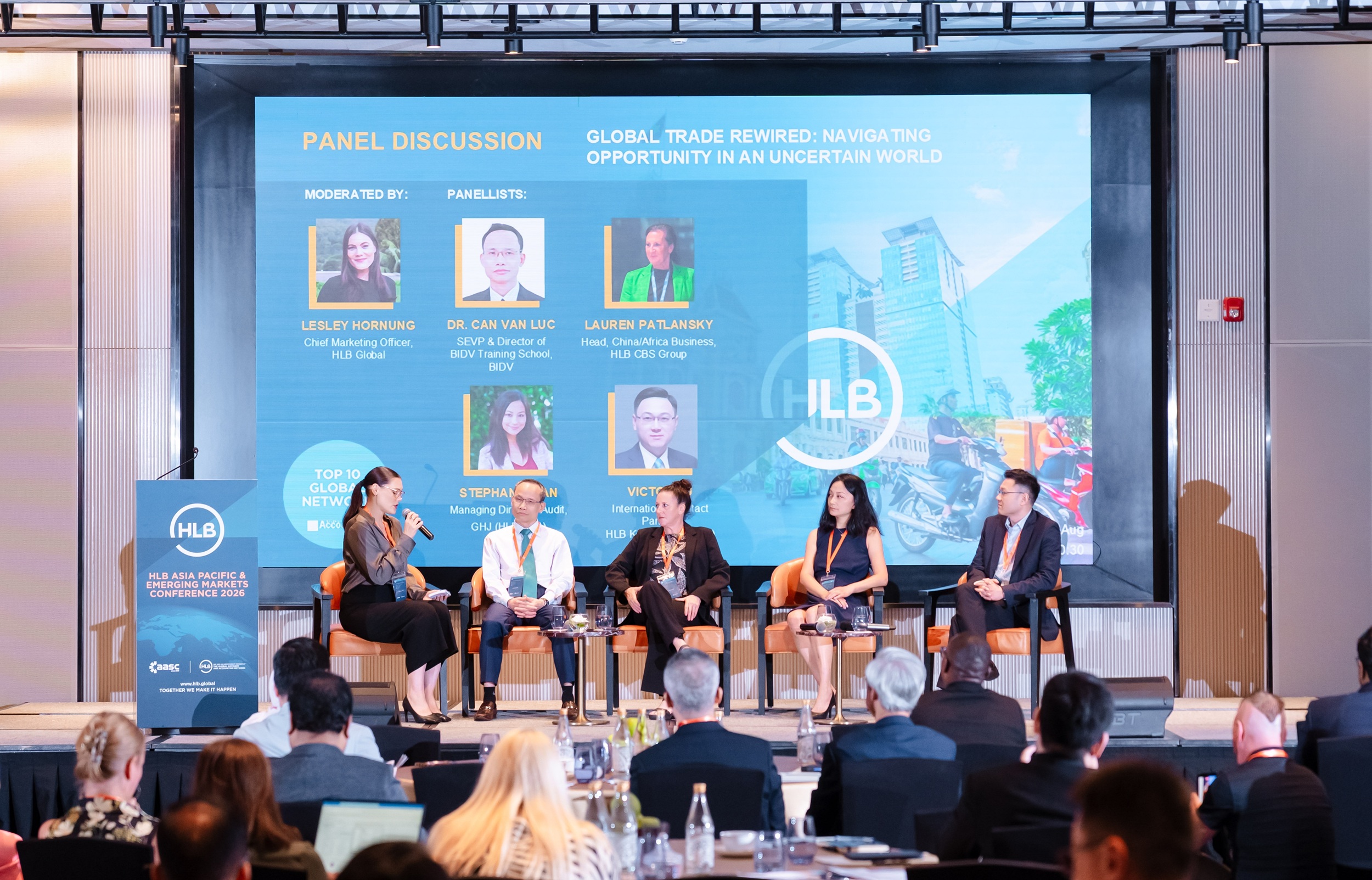
At the event, we hosted a panel discussion entitled Global Trade Rewired: Navigating Opportunity in an Uncertain World. In this session we explored how geopolitics, tariffs, technology, and changing investment patterns are reshaping international business.
For the clients we advise, there are lessons to be learnt to help tackle two key challenges. Firstly, to better understand the trends and changes that are reshaping global trade. Secondly, to assess what action can be taken to improve the success of a cross-border business strategy.
Globalisation is giving way to regionalisation
Data from UNCTAD shows that global goods trade reached approximately $13.7 trillion in the first half of 2026, 12.5% higher than 2025. Meanwhile, services trade also grew by 10.5%.
Cross-border trade is growing, despite some difficult headwinds. Tariffs, regulation, and geopolitical tension have stunted the momentum of a decades-long march towards globalisation.
So, where businesses have previously built international strategies around globalisation and efficiency, today we are seeing resilience take on just as much importance.
Our expert panel discussed the emergence of more regional trading relationships alongside greater trade fragmentation and protectionism. Businesses are having to think differently about where they invest, who they trade with, and how exposed they are to individual markets.
Crucially, this doesn't mean retreating from cross-border opportunities, but rather being more deliberate about international growth. In fact, in our work with clients, we have seen that businesses operating across several markets may actually be better placed to respond when tariffs, regulation, or political relationships change, given they are likely less reliant on any single jurisdiction from a customer, operations, or supply chain perspective.
Dr Can Van Luc, Chief Economist at the Bank for Investment and Development of Vietnam (BIDV), explained how the sudden imposition of new tariffs or restrictions can quickly alter the global trading landscape. He cited the introduction of US tariffs under Section 301 [of the Trade Act of 1974], being applied in response to certain foreign trade practices, or Section 232 [of the Trade Expansion Act of 1962], which allows restrictions on national-security grounds.
For instance, in July 2026, the US announced that it would “adopt, and effectively enforce, a ban on imports made with forced labour”, with 46 economies consequently subjected to a 12.5% tariff rate. This included a number of APAC nations: Australia, China, Hong Kong, New Zealand, Philippines, Singapore, South Korea, Thailand and Vietnam.
Diversification is creating new opportunities in APAC
Diversification in the markets you operate in can help mitigate the risk that comes with sudden changes to the global trading landscape like these.
US-China trade tension is another good example. Imports of Chinese goods into the US dropped from $536 billion in 2022 to $308 billion in 2025, while US goods exports to China fell 26% between 2024 and 2025. Subsequently, more organisations are looking to new markets to account for this issue.
“So, who is benefiting the most from that decline [of US-China trade]?” Dr Can Van Luc asked. “Vietnam is right at the top of the list.”
Vietnam’s foreign trade has grown rapidly in 2026, with total import-export turnover reaching 25% higher in the first five months of this year compared to last. Being part of global trade groups like ASEAN and having signed free trade deals with the European Union and other blocs has been important.
China's international role is evolving too. Victor Tu, International Contact Partner at HLB China, described a shift from simply exporting goods towards Chinese companies establishing operations closer to their customers overseas. Stephanie Yan, Managing Director at GHJ (HLB USA), summarised the change neatly: what was once primarily "made in China" is increasingly "made by China" around the world.
For businesses across Asia Pacific, these shifts create opportunities for new partnerships, customers and investment. But diversification isn't simply a matter of picking another country on the map. Political stability, regulation, infrastructure, taxation, and the ability to move money between jurisdictions all need to be considered.
The rules of competitiveness are changing
Another important point from our discussion was that businesses are navigating several transformations simultaneously. Dr Can Van Luc highlighted four in particular: digitalisation, the green transition, energy, and labour.
Sustainability is a good example. Environmental requirements are increasingly influencing trade and investment decisions, while APAC countries (including Vietnam) are looking more selectively at the type of foreign direct investment they want to attract.
Digitalisation is changing business models at the same time. Energy availability and security can influence where businesses invest, particularly in energy-intensive sectors (such as for firms producing electric vehicles, solar panels and batteries), while access to talent remains critical.
Taken in combination, these factors have significantly altered the way in which organisations need to think about potential targets for growth at both a regional and international level. And from a financial perspective, it is critical to how we advise clients on their cross-border business goals.
A decision about where to establish an operation, for instance, may involve tax and labour costs but also energy availability, environmental requirements, digital infrastructure, and future regulation. The best decision on paper may not always be the most resilient one in practice. Both upfront capital expenditure and ongoing operational costs must be considered in light of the various investments required to expand into a chosen market. Mapping out those costs is central to strategic decisions regarding cross-border growth.

"Businesses don’t have five or ten years to develop an international strategy; they may need to establish a company, hire people or respond to a new commercial opportunity now."
Victor Tu; International Contact Partner, HLB China
Balancing speed with expert advice
Perhaps the most practical message from the panel concerned the speed at which businesses now need to respond. Victor Tu stressed that businesses don’t have five or ten years to develop an international strategy; they may need to establish a company, hire people or respond to a new commercial opportunity now.
Speed, however, must be balanced carefully against the need for thorough preparation. Stephanie Yan made that point directly: “It's too late when you come to me and say, ‘I set up this company in this country’. I want to be in the conversation early on.”
Her next observation underlined why seeking advice early is crucial: “When a good deal is structured the wrong way, it becomes a mediocre deal very quickly.”
These expansion decisions can create tax, regulatory, employment, financing and reporting consequences across several jurisdictions. Resolving those issues after the event can be considerably harder than addressing them at the outset.

"It's too late when you come to me and say, ‘I set up this company in this country’. I want to be in the conversation early on. When a good deal is structured the wrong way, it becomes a mediocre deal very quickly.”
Stephanie Yan; Managing Director, GHJ (HLB USA)
Turning uncertainty into opportunity
There are very few things you can be certain of in business, but the fact that the geopolitical and economic landscape will continue to change is one. Global trade is always evolving and, for the most part, that is out of your control; businesses can't dictate the direction of tariffs, the outcome of elections, or write the next trade policy. The changes in the APAC region over recent years underline this point.
What you – and we – can control is how best to prepare for and respond to change.
For all of us across HLB’s global network, that means helping clients look beyond individual transactions and understand the wider implications of their international decisions. It also means connecting expertise across our network so that a business considering an opportunity in Vietnam, China, Singapore, or elsewhere can combine local knowledge with a genuinely international perspective.
While global trade continues to grow, the world is becoming more fragmented. This means that opportunities still exist, but the right strategy is more important than ever, and our advisory teams are ready to support your organisation’s journey.
Related content